Israel: Defense Budget Vs. Social Justice

This post is part of our International Relations & Security coverage.
One of the major results of the social justice protests in Israel in the last year has been a renewed debate about the budgetary priorities of the state. The social justice movement (also known as #j14) demanded a more equal distribution of wealth in Israel, including funneling a greater share of the budget to welfare services for the population such as subsidizes housing, free education, and better medical services, at the expense of current budgetary priorities – namely, the defense budget which always keeps rising.
Blogger Tomer Israeli [he] explained the logic shared by many #j14 protesters:
Blogger Ziv Turner [he] blasted the current Israeli government for managing to simultaneously collect heavy taxes from the population that struggles to make ends meet, while increasing the deficit and not providing the population with adequate services. He writes:
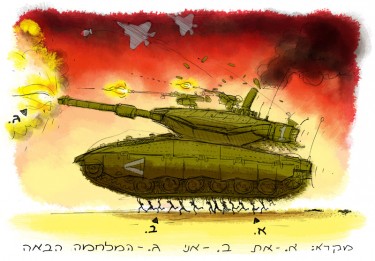
Cartoon of The Defense Budget by Amitai Sandy. Used with permission. Text from right-to-left: A-You, B-Me, C-the next war.
Writing in the blog +972 Magazine, Timna Axel discussed the influence of the defense budget and the occupation of the Palestinian territories on social inequality in Israel:
And then there is the slashing of social expenditures in the budget, which during the second Intifadah totaled NIS 65 billion, while the defense budget increased by NIS 15 billion. Cuts to child allowances and unemployment pay have caused a consistent rise in the poverty rate, and government income transfers designed to combat it make an even smaller dent in poverty now than they did in the 1980s. The report quotes economist Momi Dahan, who writes that “an in-depth analysis of the factors causing Israel to have more poor than any other developed country cannot overlook the fact that Israel spends seven percent of its GDP on defense, compared with 1.5 percent on average in the other developed countries.”
Blogger Yuval Ron [he] on the other hand, saw the settlements in the occupied Palestinian territories as a way to decrease the defense budget, writing:
 This post and its translations to Spanish, Arabic and French were commissioned by the International Security Network (ISN) as part of a partnership to seek out citizen voices on international relations and security issues worldwide. This post was first published on the ISN blog, see similar stories here.