Stories about Sub-Saharan Africa from May, 2007
Uganda: What if we blogged in local languages?
Country Boyi asks, “What if we blogged in local languages?“: “I've been thinking. It took a workshop on writing for children in Ugandan local languages to have me thinking: what clearly is the importance of indigenous languages, and would it add any value if we blogged in our home languages?”
Kenya: are you a regular Mzalendo user in Nairobi?
Mzalendo is looking for its users in Nairobi: “Are you a regular Mzalendo user based in Nairobi? If you are interested in being interviewed on your views about Mzalendo by Reuters, please get in touch with us via the contact page.”
Benin: New government rumored to be considering a Ministry of Religion
Babilown points to an article in Le Matin (Fr) about rumors that Benin's government plans to create a Ministry of Religion, and outlines the potential of such a ministry to erode the constitutional separation of church and state (Fr). In a comment, T. Nouatin agrees that although a Ministry of...
New Book Examines Causes of the D.R. of Congo's Political Instability
Congopage offers a brief review of a new book by Gilbert Dzassabi, a lieutenant-colonel of the Congolese Air Force (Congo-Brazzaville) who studied in Russia and later in France, where he earned a Ph.D in political science. Dzassabi tries to explain why his country's troubled neighbor, the Democratic Republic of the...
DRC: Congolese Curious About Money Ocean's 13 Stars Raised for Darfur
Bien au Bout… writes about his neighbor, Karim, who asked to be shown photographs of Brad Pitt and George Clooney (Fr). Apparently, Karim was listening to the BBC and heard about an event in Cannes organized by Ocean's 13 stars Pitt, Clooney, Matt Damon and Don Cheadle that raised $9.2...
South Africa: is the South African blogosphere entirely white?
Izzonline writes about race and blogging in South Africa: “Not that it's worrying. But a small concern it is. The SA blogosphere is nearly entirely white – I realised since starting to blog. I went across many blogs on Amatomu, the SA blog aggregator, and you hardly ever come across...
Zambia: corruption wars
Cho discusses corruption wars in Zambia: “I have watched with some amazement at the recent flurry of discussions on corruption following the London judgement on our ex President FTJ. The issue has been much debated on every Zambian blog, forum and newspaper. As always these discussions have been led from...
Zambia: Zambian art: a woman from the lake
A woman from the lake is one of Cho's Zambian art collection.
Cameroon: Nkuma, a new movie about female genital mutilation
Dibussi Tande reviews a new Cameroonian movie, Nkuma: “Nkuma is a simple but interesting film which shows that FGM is a complex issue which is more than just about the sexist agenda of patriarchal Africa. It also has the merit of steering away from off-putting preachy and moralistic discourse aimed...
How the South is financing the North's internet connection
Reseau International de correspondants writes about pricing inequalities in the international telecom system (Fr) that place a disproportionate burden of payment on developing countries to the extent that “the South is financing the North” and it is in effect “three times more expensive to connect to the internet” in developing...
Guinean proverb
Roots and Culture posts a Guinean proverb: “When ants work together they carry lift elephants.” (Fr)
Morocco's UN Refugee Office Closes its Doors
Cat in Rabat reports that The United Nations Refugee Office in Morocco has closed its doors after African migrants stormed the building on Saturday. “They were demanding financial assistance for accommodation and food, as well as residency papers, access to healthcare, and the right to work,” she says, adding: “There...
Qatar: Why Somalia isn't Iraq
Qatar-based blogger Abdurahman Warsame explains why Somalia isn't like Iraq. “There has been bomb attacks in Mogadishu since the city fell to the Transitional Government. A number of civilians were killed in various attacks, the prime minister Ali Ghedi and Mayor of Mogadishu, former warlord Mohamed Dheere, have both survived...
Darfur: The Reality, the Agenda & the Proposed Solution
Darfur, in the minds of different people, constitutes and means different things. This is due to the fact that we, the general public around the world are getting exposed to a tirade of conflicting views and information. As that continues, so will our polarization. Therefore, the long and seemingly endless...

Join the Debate on Darfur 10am (EST) TODAY!
Further to our earlier post, here's a quick update on the Reuters Newsmaker event on Darfur, which takes place in New York starting at 10am EST today. Our Sub-Saharan Africa editor Ndesanjo Macha will be live-blogging the event at his blog, Jikomboe, so you'll be able to follow the proceedings there. Reuters will be tossing to the GV team from time to time for questions and feedback, so please leave any comments you may have either on this post or on Ndesanjo's blog. In related news, Reuters Alertnet this morning released the results of its poll on the situation of Aid workers in Darfur (full coverage here).
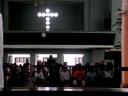
D.R. of Congo: Should Christian Revivalist Churches Be Encouraging Political Activism?
Continuing an age-old debate--is religion the "opium of the people" or can it be a catalyst for social change?--Congolese blogger Blaise Mantoto at UDPS Liege says the Congo’s Christian revivalist churches, which he cynically refers to as "for-profit spiritual shops," encourage political disengagement. He argues these churches should inspire their followers to improve their social conditions through political activism, but not everyone agrees that religion and politics ought to be mixed.
Human Sacrifice & the Politics of Death
At Babilown, French-Beninian author Blaise Aplognan describes the religious and political function of human sacrifice (Fr) in ancient societies: “…its goal was to channel violence toward a (sacrificed) individual, toward the sacred realm, institutionalizing violence by supervising it and practicing it according to very precise rules and rituals.”
Sudan: Blogging From the Conflict Zone
Increasingly, aid workers, volunteers and even peacekeepers use blogs to share their unique experiences and insights from conflict zones. Take the Darfur conflict in Sudan, for example. Sleepless in Sudan was one of the first blogs to highlight the untold suffering of innocent people in Darfur. Sleepless in Sudan, which was nominated in the 2006 "Bloggies" Weblog Award contest, was maintained by a female aid worker stationed in Darfur. For nine months, Sleepless in Sudan told stories of life in Darfur from the ground.
South Africa: politician invited to create an iblog
The owner of iblog, Mark Garbers, invites the leader of Independe Democrats in South Africa to create an iblog: “Dear ibloggers, Although I don’t normally personally invite people to create an iblog, I thought that in light of the coverage that blogging is receiving, inviting Patricia De Lille to sign...
Sudan: If there were a transcript…
Ingrid at Sudan Watch on the Debate on Darfur: “Heh. Rock on Drima! Why no webcast? If there were a transcript, I'd mull over John Prendergast's commentary in the hope of getting some understanding of the rationale behind his warmongering stance on Sudan.”
D. R. Congo: Park Rangers Attacked, Flying over Katanga, Music meets Social Activism, and Ants 2 – Brian 0
Access to the Internet in the Democratic Republic of Congo is gradually improving (World Bank figures suggest there are already over 6 million users), but will remain prohibitively expensive as long as service providers are dependent on satellite connections. In such a context, it should come as no surprise that there are only a handful of Congolese bloggers. Chatrooms and instant messaging are very popular, however, and with the influence of the Diaspora, it’s easy to imagine that many more young Congolese people will soon be following the footsteps of pioneers like Cedric, perhaps blogging in Lingala, Luba, Kikongo and Swahili as well as French.
About our Sub-Saharan Africa coverage